



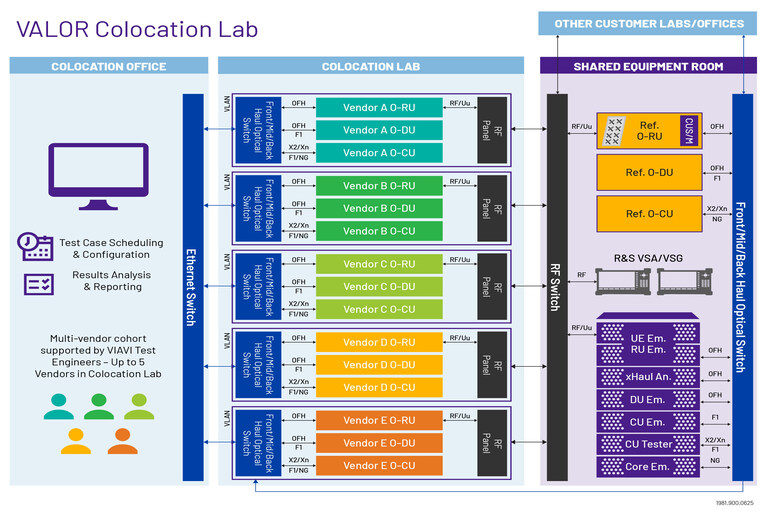
VIAVI Solutions Inc. has announced the addition of colocation capabilities to its VALOR (VIAVI Automated Lab-as-a-Service for Open RAN) facility. This expansion addresses growing demand from Open RAN vendors for scalable, long-term, and secure testing environments. Funded by the U.S. NTIA Public Wireless Supply Chain Innovation Fund (PWSCIF), the VALOR lab is based in Chandler, Arizona.
The new colocation model supplements VIAVI’s existing on-demand lab services by offering enhanced flexibility. Customers can now establish semi-permanent setups, allowing for continuous testing throughout the entire product lifecycle. Each client’s environment is securely isolated using VLANs, ensuring dedicated performance and data protection for complex testing scenarios.
“With this new colocation model, VALOR now supports both short-term targeted testing and long-term, end-to-end validation,” said Erik Probstfield, Senior Director of VALOR at VIAVI. “This dual engagement approach meets a broader range of customer needs, from development to pre-certification and beyond.”
Probstfield noted that the expansion aligns with the goals of the NTIA PWSCIF: “This investment framework accelerates innovation by combining federal funding with private industry participation, strengthening the open and secure wireless ecosystem.”
Read:https://demo.webnewsaddiction.com/2025/07/03/picoscope-9400a-series-reaches-new-high-with-33-ghz-bandwidth/
VALOR continues to offer a fully automated, vendor-neutral Lab-as-a-Service and Test-as-a-Service platform focused on Open RAN interoperability, performance, and security. In addition to colocation and on-demand labs, the facility features a state-of-the-art RF chamber for over-the-air validation of Massive MIMO and beamforming, supporting up to 16 spatial layers.
Built on VIAVI’s NITRO Wireless Open RAN Test Suite and VAMOS hybrid testing framework, VALOR enables emerging vendors to test and validate Open RAN solutions without the burden of building internal infrastructure. This approach accelerates time-to-market and lowers development risk, making it easier for new entrants to scale confidently.