



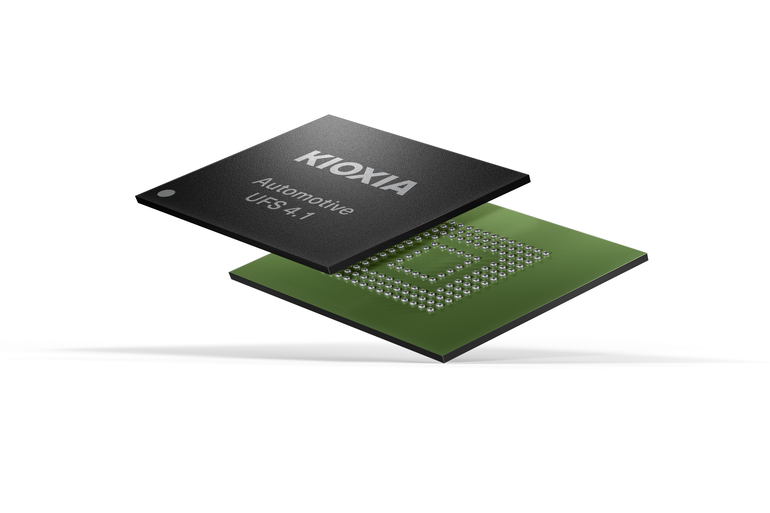
Kioxia Corporation, a global leader in memory solutions, announced the sampling of its next-generation Universal Flash Storage (UFS) Ver. 4.1 embedded memory devices, engineered for high-performance automotive applications. These advanced UFS devices are powered by Kioxia’s Generation 8 BiCS FLASH 3D memory and an in-house designed controller, delivering major upgrades in performance, flexibility, and diagnostics.
Available in 128GB, 256GB, 512GB, and 1TB capacities, Kioxia’s UFS 4.1 solutions target demanding automotive environments such as infotainment systems, ADAS (Advanced Driver Assistance Systems), telematics, domain controllers, and vehicle computers. The devices meet AEC-Q100/104 Grade 2 standards and are qualified for temperatures up to 115°C.
Elevating the performance from Kioxia’s UFS 3.1 generation(4), the new UFS 4.1 (512GB) devices deliver:
- Approximately 2.1 times sequential read performance
- Approximately 2.5 times sequential write performance
- Approximately 2.1 times random read performance
- Approximately 3.7 times random write performance
These improvements provide a more responsive user experience in data-intensive automotive environments.
Key features include:
- Compliant with the UFS 4.1 Specification, which includes WriteBooster related extensions such as WriteBooster Buffer Resizing and Pinned Partial Flush Mode which provides better flexibility for optimal performance. UFS 4.1 is backward compatible with UFS 4.0 and UFS 3.1.
- Enhanced Diagnostic Capabilities, including a newly added vendor-specific device health descriptor, simplifying device status monitoring and predictive maintenance.
- Uses generation 8 BiCS FLASH 3D flash memory.
UFS 4.1 devices from Kioxia integrate the company’s innovative BiCS FLASH 3D flash memory and a controller in a JEDEC-standard package. These new UFS devices are built with Kioxia’s generation 8 BiCS FLASH 3D flash memory. This generation introduces CBA (CMOS directly Bonded to Array) technology, an architectural innovation that marks a step-change in flash memory design. By directly bonding the CMOS circuitry to the memory array, CBA technology enables major gains in power efficiency, performance, and density.
Notes
(1) Sample shipments of the 1TB device began in June, 128GB and 256GB device began in July. Specification of the samples may differ from commercial products.
(2) Universal Flash Storage (UFS) is a product category for a class of embedded memory products built to the JEDEC UFS standard specification. Due to its serial interface, UFS supports full duplexing, which enables both concurrent reading and writing between the host processor and UFS device.
(3) Electrical component qualification requirements defined by the AEC (Automotive Electronics Council).
(4) UFS 3.1 512GB device “THGJFGT2T85BAB5”.
*In every mention of a Kioxia product: Product density is identified based on the density of memory chip(s) within the Product, not the amount of memory capacity available for data storage by the end user. Consumer-usable capacity will be less due to overhead data areas, formatting, bad blocks, and other constraints, and may also vary based on the host device and application. For details, please refer to applicable product specifications. The definition of 1 KB = 2^10 bytes = 1,024 bytes. The definition of 1 Gb = 2^30 bits = 1,073,741,824 bits. The definition of 1 GB = 2^30 bytes = 1,073,741,824 bytes. 1 Tb = 2^40 bits = 1,099,511,627,776 bits. 1 TB = 2^40 bytes = 1,099,511,627,776 bytes.
*MB/s is calculated as 1,000,000 bytes/s.
*Read and write speeds are the best values obtained in a specific test environment at Kioxia Corporation and Kioxia Corporation warrants neither read nor write speeds in individual devices. Read and write speed may vary depending on device used and file size read or written.
*Company names, product names and service names may be trademarks of third-party companies.