


With nearly 10,000 satellites currently operating in low Earth orbit (LEO), supporting everything from global internet access to earth observation and communications, the demand for LEO-optimized technology is accelerating. To meet these specialized needs, Infineon Technologies AG has introduced a new portfolio of radiation-tolerant memory products, tailored specifically for the fast-growing NewSpace market.
NewSpace refers to the commercialization of space exploration by private companies and startups, often with less governmental oversight than traditional space programs. Driven by the rising demand for global connectivity (direct-to-cell), NewSpace initiatives aim to combine LEO satellite constellations with the Internet of Things (IoT) to create a more connected and efficient world. These missions typically rely on smaller satellites, ranging from nano-sats to 250 kg Sats, and are shorter in mission duration and less expensive, enabling the deployment of large-scale LEO constellations. With lower launch costs and reduced radiation exposure in LEO, many NewSpace applications can benefit from commercial off-the-shelf (COTS) components that deliver robust performance without requiring traditional military or aerospace qualifications.
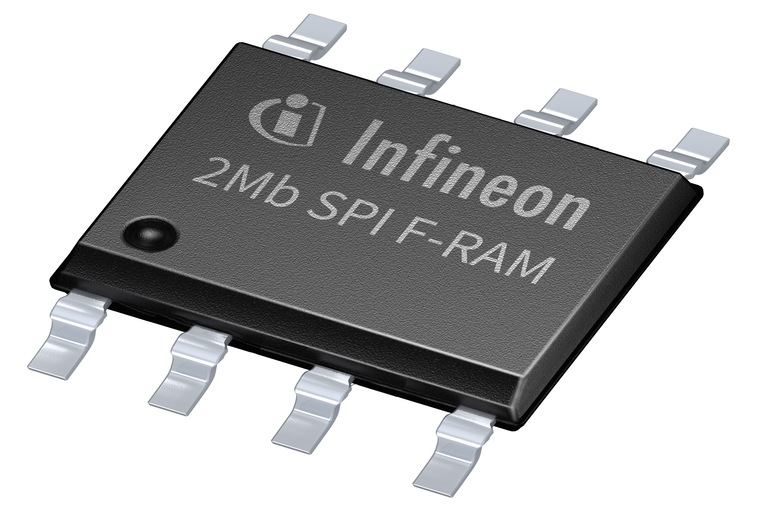
Infineon’s NewSpace memory portfolio includes three product families: low-power, radiation-tolerant F-RAMs; QSPI NOR flash memories with 256 Mbit and 512 Mbit densities; and 256 Mbit/512 Mbit pseudo-static RAM (pSRAM). These devices offer an optimal combination of performance and reliability while supporting reduced size, weight, power, and cost benefits (SWaP-c). The F-RAMs operate across a wide MIL temperature range of -55°C to +125 °C, while the NOR Flash and pSRAM devices support a range of -40°C to +125°C. Radiation tolerance demonstrates a total ionizing dose (TID) rating of 50 krad(Si) for the F-RAMs, 30 krad(Si) for the NOR Flash, and 100 krad(Si) for the pSRAM. Additional benefits include single lot date code and 100 percent electrical testing to ensure reliable mission operation. With these characteristics, Infineon’s memory products are ideal for short-duration, high-redundancy, and large-scale LEO constellations.
Infineon’s pSRAM are the first of their kind for NewSpace, offering a unique memory type, whose memory array is structured like DRAM internally but presents itself like static RAM (SRAM) externally. The pSRAMs are a low-power, high-performance, and low pin-count solution that is ideal for high-throughput data buffering applications.
Radiation-tolerant power solutions from IR HiRel complement memory offering
In addition to the NewSpace memory solutions, Infineon’s IR HiRel group offers a broad portfolio of radiation-tolerant power devices designed for the commercial space market. Combining decades of experience in both aerospace and automotive, the portfolio features highly reliable, cost-effective power MOSFETs optimized for 2-to-5-year LEO missions. Available in 60 V and 150 V N- and P-channel variants, these devices are qualified to AEC-Q101 and come in a rugged plastic package, with options for surface-mount and through-hole mounting. The devices are rated for a TID of 30 krad(Si), supporting radiation requirements of modern LEO missions.
Availability
Infineon’s NewSpace memory and power products are available through authorized distribution partners Arrow and Avnet.